Showing posts with label solo. Show all posts

Wednesday, July 4, 2012

Solo Batik Carnival

Solo Batik Carnival
Solo Batik Carnival
No need to Sao Paulo, Brazil to see the fashion carnival. The city of Solo in Central Java also has a Solo Batik Carnival (SBC) which is not less glorious costumes. Solo Batik Carnival (SBC) successfully attracted thousands of spectators. Solo Batik Carnival held a carnival which confirms batik as an icon of Solo. Solo is famous as the city of batik. Village Laweyan and Village Kauman prove it. Batik has grown and evolved into a batik business in the small village for hundreds of years.


The main costumes are made ​​from a luxurious and magnificent batik and colored lights, making the special performances of Solo Batik Carnival. No wonder the thousands of spectators coming from various places and crowded streets that serve as the location of the parade. Implementation date Solo Batik Carnival is always changing every year, but starting in 2009 Solo Batik Carnival is always held in June.


Solo Batik Carnival (SBC) is followed by no less than 250 participants. Not just local participants, Solo Batik Carnival (SBC) is also enlivened by Miss Indonesia, among others, Miss Indonesia, Miss Environment, and Miss Tourism.


Each year, Solo Batik Carnival brings a different theme such as "Mask", "Flower of the world", and "Miracle Legend". These themes are then translated through the costume design of the participants that unique and creative. 'The style of classical batik' combined with 'contemporary batik' and decorated with beads and the crown, making the costumes more lively. Currently Solo Batik Carnival continues to improve itself in order to become one of the carnival were taken into account in the international arena.


Started From Sriwedari Stadium, then pass through Slamet Riyadi Street eastwards towards Gladag roundabout, then turn left into Sudirman Street and will end at City Hall of Surakarta. The distance of more than 3 kilometers.


The participants waddle in the street with a cool costume. Well the difference with the carnival in Brazil, there is no carnival participants which uses a decorated car. The parade conducted on foot.


Solo Batik Carnival (SBC) is one of the entertainment of the people who are very eagerly awaited, is evident from the enthusiastic crowd that came. Spectators who have been waiting for the carnival since the afternoon, immediately pushed into the middle of the road when the carnival begins.

Friday, June 22, 2012

Solo The City of Batik

kampung batik laweyan, solo
Solo as a city of batik that inherits the values of Javanese culture. for this purpose, the annual event held in Solo 'Solo Batik Carnival'. At the carnival activities undertaken in the main streets of the city of Solo, will be featured more than 350 participants dressed in batik designs.

batik solo
batik and heritage of the spirit 'of Javanese culture' that is embedded in the city of Solo, was absolutely right, because after all for the people of Solo, batik and 'Javanese culture' are the two things are inseparable. since the first age, people of Solo are wearing batik, in both events at the palace as well as in everyday life. In addition, in Solo we can find traces of power and cultural history of Java.

Looking at the history of the city of Solo, then we will find that the city of Solo in the Sultanate of Mataram was founded in 1745 in the village of Sala on the banks of Bengawan Solo River and had been a seat of government at the end of the Sultanate. When it finally broke, then Solo became the center government of 'Kasunanan Surakarta' and 'Praja Mangkunegara'.

In the process, 'the palace Solo' as the heir to the history of Java. prioritizes the values ​​of Javanese culture. A variety of historic buildings, art products, and traditional foods can still be found in Solo, one of which is Kampung Batik Laweyan.

Kampung Batik Laweyan is the center of batik in Solo which historically has been there since the days of empire Display in 1546. In the history of its development, when Solo became an important trading town.

kampung batik laweyan solo
visit the region of this batik village, then we will see an area that is designed with an integrated concept, where hundreds of batik artisans make and sell various batik motifs such as Tirto Tejo and Truntum with varying prices. Here visitors are invited around the narrow alleys 'public housing' that high-walled compound. Given the history and significance of this region, the City of Solo has long ago protect the building that has a wealth of ancient Javanese architecture, and foster the continuity of batik craft industry in the region, and make it as a historical tourist area.

You can see for yourself the condition of the river environment of the legendary Bengawan Solo while understanding the historical values inherent in this river. The Sultanate of Mataram building was first founded in this river, the predecessor of Surakarta and Praja Kasunanan Mangkunegara.

kampung batik laweyan solo

Tuesday, June 19, 2012

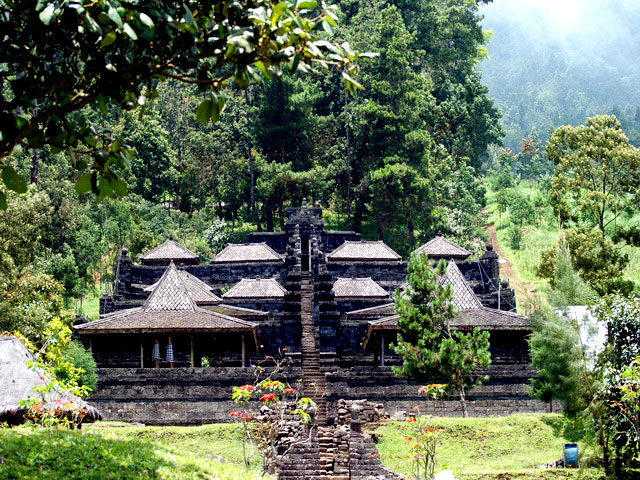
Exploring the uniqueness of Cetho Temple, Central Java

cetho temple by indonesian tourism
Cetho Temple
The countryside on Gunung Lawus slopes is amazing. Rolling hills, valleys and plateaus, coffee groves and vegetable plots give way to tea plantations at about 1,000 m. At 1,400 m and some fifteen kilometres from Temple Sukuh lies Temple Cetho which sits at the top of a steeply sloping Hindu village of the same name. It dates from the same period as Sukuh, but could not be more different. It is an exquisitely attractive place, even if little visited.

cetho temple by indonesian tourism
Cetho Temple
Temple Cetho (Javanese spelling: ceth) is a Hindu temple-style relics of the end of the Majapahit (15th century). The first scientific report about it was made by Van de Vlies in 1842. A.J. Bernet Kempers also do some research about it. Excavation (digging) for the purpose of reconstruction was first performed in 1928 by the Archaeological Department of the Dutch East Indies. Under the circumstances when the ruins began to study, this temple has not aged that much with Sukuh. This temple is located in the hamlet of Ceto, Gumeng Village, District Jenawi, Karanganyar district, at an altitude of 1400m above sea level.

cetho temple by indonesian tourism
Cetho Temple
When was found, the state of this temple is a stone ruins on the fourteen-story plains, extending from the west (lowest) to the east, although at present there are only 13 terrace, and the restoration carried out only nine terraces. Structure with many terraces, making up the prediction of the original culture revival ("punden staircase") at the time, which is synthesized by the Hindu religion. This suspicion is strengthened by the body shape in relief that like a puppet, which is similar to the depiction in Sukuh.


In the "temple Cetho" there is a symbol of phallus (penis, male genitalia) about 2 meter long, equipped with a decorative piercing (piercing) of ampallang type.
In addition there are depictions of other animals, such as horseshoe crabs, frogs, and crayfish. Animal symbols that exist, can be read as "suryasengkala" with the number of 1373 Saka, or 1451 in the modern era.

cetho temple by indonesian tourism
Cetho Temple

 
Design by Wordpress Theme | Bloggerized by Free Blogger Templates | coupon codes | Privacy Policy | author